

Bangkok and the centre
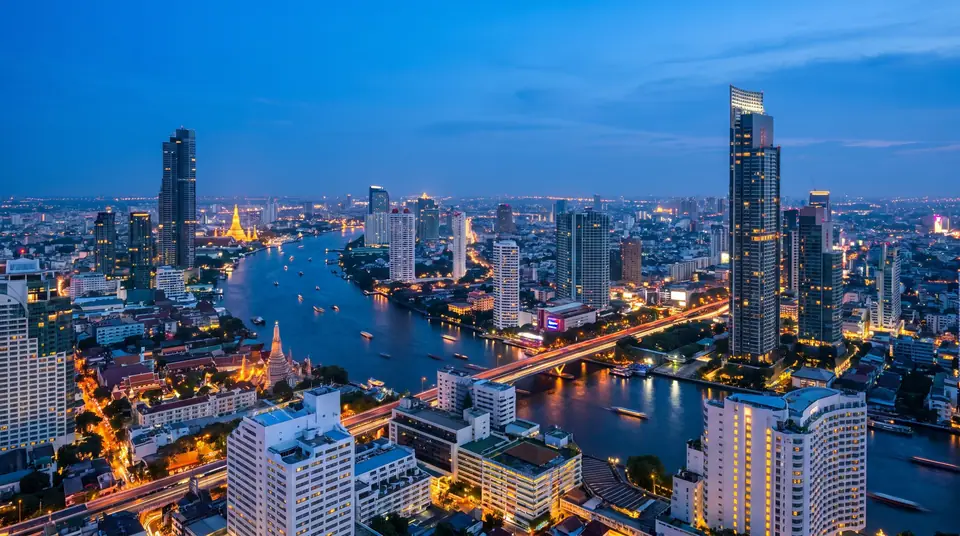
Bangkok's palaces and river temples, Ayutthaya (the former royal capital and a UNESCO World Heritage site, about 80 km north), the Damnoen Saduak floating market and Hua Hin.
- Getting there
- Day trips by train, van or car
Thailand · Travel Q&A
Short answers first, then the detail: entry rules, airports, getting between cities, money, mobile data, weather, the laws that catch visitors out, and who to call.
Updated · Checked against official sources
Most visitors from 60 countries and territories can enter Thailand without a visa for up to 30 days (tourism only) under the rules in force since 15 September 2026, and everyone must file the free Thailand Digital Arrival Card (TDAC) within the 3 days before arrival. The Tourist Police number is 1155, and the rainy season runs from mid-May to mid-October.
Short answer: 30 days visa-free for tourism (60 countries and territories, since 15 September 2026), and yes: every non-Thai traveler, children included, files the free TDAC within the 3 days before arrival.
The list includes the USA, UK, Canada, Australia, all EU states, Switzerland, Norway, Japan, New Zealand, India, Singapore, Malaysia, Taiwan and the UAE; anyone admitted before 15 September may stay until the date stamped in their passport. Visa on Arrival (15 days, 2,000 THB) now covers only Azerbaijan, Belarus and Serbia, and bilateral agreements continue (90 days for South Korea, for example).
Everyone who is not Thai, arriving by air, land or sea, has needed the Thailand Digital Arrival Card since 1 May 2025. File it within the 3 days before arrival (arrival day included), up to 10 people per submission, with a new card for every entry. Transit passengers who stay airside and crew are exempt; the THIM app (launched 25 September 2026) is an optional way to file.
Fake TDAC sites charge roughly US$10 to 90 for the free form and collect passport data; in March 2026 the Immigration Bureau said at least 10% of foreign arrivals had used one. Only tdac.immigration.go.th and the THIM app are official.
Is there an ETA or entry fee? No. The Electronic Travel Authorisation announced in 2024 never launched, and the proposed 450 THB tourism fee is still a draft (early 2027 is the stated target); nothing is collected today.
Short answer: most long-haul flights land at Suvarnabhumi Airport (BKK), about 30 km from central Bangkok, and many low-cost flights at Don Mueang Airport (DMK). From both you can take a meter taxi (meter + 50 THB surcharge + tolls), a train, a ride-hailing car or a pre-booked car.
| Option | Suvarnabhumi (BKK) | Don Mueang (DMK) |
|---|---|---|
| Public meter taxi | Level 1, between Gates 4 and 7, 24 hours; meter + 50 THB surcharge + tolls | Terminal 1, 1st floor, Gate 8; Terminal 2 next to Gate 15; meter + 50 THB + tolls |
| Rail | Airport Rail Link from Level B1, 05:30–24:00, 15–45 THB (45 THB to Phaya Thai, about 27 minutes) | SRT Red Line from Don Mueang station, 12–42 THB (33 THB to Krung Thep Aphiwat) |
| Ride-hailing | Grab pickup at Level 1, Gate 4 (designated by the airport) | Use a certified app; confirm the pickup point in the app |
| Pre-booked car | Fixed price per vehicle; the meeting point is confirmed with your booking | |
Luggage fees, the regional airports (Phuket, Krabi, Chiang Mai, U-Tapao, Sukhothai, Khon Kaen, Udon Thani, Ubon Ratchathani) and how far each is from town are on the Thailand airport transfers page.
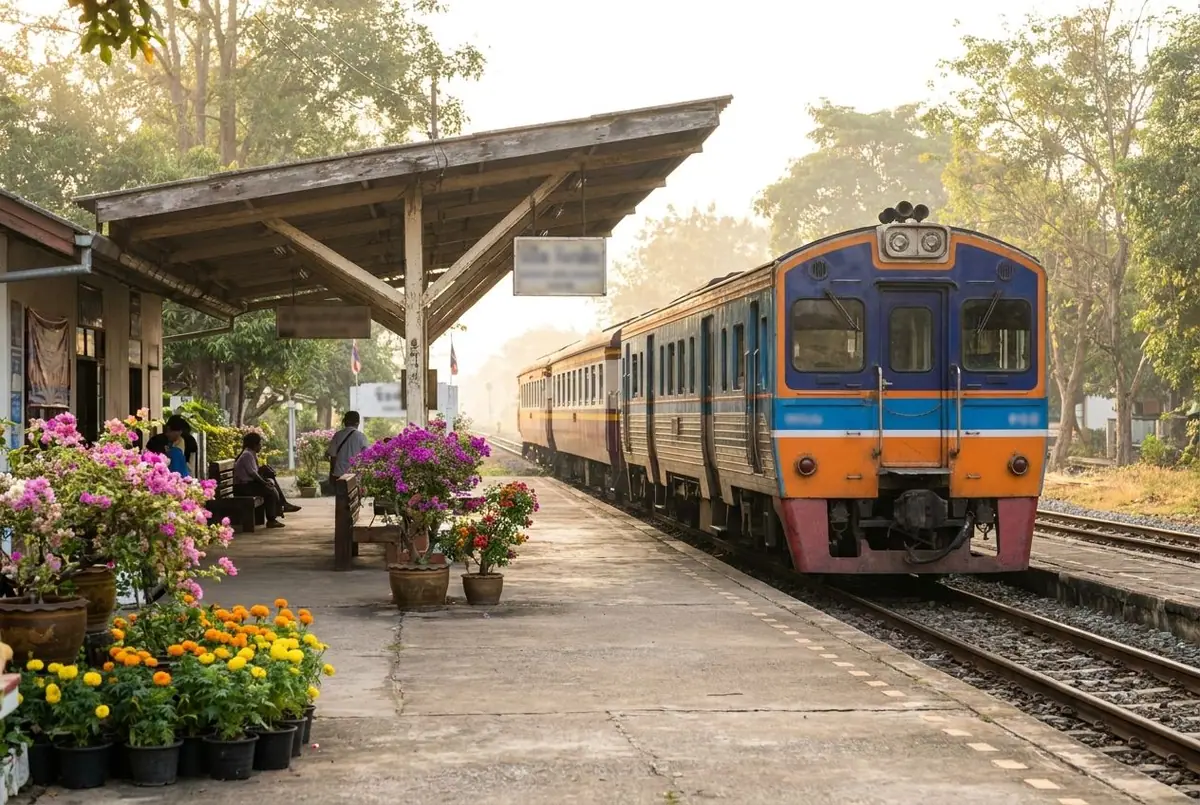
Short answer: up to about 3 hours by road (Pattaya, Hua Hin, Ayutthaya, Kanchanaburi, Khao Yai), take a bus, minivan or car; for Chiang Mai (685–700 km) or the far north-east, fly or take the night train; for islands, go by road to the pier and buy the boat ticket there.
| Mode | Suits | Good to know |
|---|---|---|
| Train (State Railway of Thailand) | Overnight sleepers to Chiang Mai, Nong Khai and Ubon Ratchathani; Hua Hin; the western line to Kanchanaburi | Check which Bangkok station your ticket names |
| Long-distance bus and minivan | Cheap trips to most towns | Terminals by direction: Mo Chit (north, north-east), Ekkamai (east coast), Southern Bus Terminal (west, south) |
| Domestic flight | Chiang Mai, Phuket, Krabi, the north-east; Sukhothai (THS) from BKK, Phitsanulok (PHS) from DMK | BKK and DMK are separate airports; check which one your ticket names |
| Private car with driver | Families, luggage, door to door | Network fares are per vehicle, one way, tolls included; ferries and park fees extra |
| Ride-hailing app | City trips | Legal only via a certified app, registered car and licensed driver; stricter enforcement from 1 October 2026 |
| Bangkok meter taxi | City trips | Flag fall 35 THB (large taxis 40 THB); +20 THB if booked by phone or app |
Distances and realistic drive times for 16 destinations, from Pattaya and Hua Hin to Udon Thani and Chiang Mai, are in the road trips from Bangkok table.
Look at the plate. Yellow means registered for hire; green with white characters is a licensed "service car" (airport and hotel transfers, tour cars); white is private and not licensed to sell rides, except app ride-hailing cars, which keep white plates but carry Department of Land Transport stickers. A paid van (more than 7 seats) should have a yellow plate numbered in the 30s.
Short answer: the centre for temples and food, the north for mountains and old capitals, Isan for Khmer ruins and the Mekong, the east and south for beaches, the west for the River Kwai.
Bangkok's palaces and river temples, Ayutthaya (the former royal capital and a UNESCO World Heritage site, about 80 km north), the Damnoen Saduak floating market and Hua Hin.

Chiang Mai's old city and Doi Suthep, the road to Pai, Chiang Rai's temples and Sukhothai Historical Park. Chiang Mai is roughly 700 km from Bangkok.

Khao Yai National Park, Korat (Nakhon Ratchasima) and Phimai's Khmer temple, Khon Kaen, Udon Thani and Nong Khai (the Friendship Bridge to Laos), and Ubon Ratchathani with Khong Chiam on the Mekong.

Pattaya is 1.5 to 2 hours by road from Suvarnabhumi. For Koh Samet you drive to Ban Phe pier and take a boat; Koh Chang ferries leave from piers near Trat.

The Andaman coast (Phuket, Krabi, Ao Nang, Railay) is wettest from May to October; the Gulf islands such as Koh Samui from about October to December.

The Bridge over the River Kwai and Kanchanaburi's Second World War sites, Erawan Falls, Hellfire Pass and the raft-house resorts of Sai Yok along Highway 323.
Short answer: 250 THB per withdrawal with a Visa, UnionPay or JCB card and 350 THB with a Mastercard, per the fee schedules of SCB (from 1 September 2026) and Krungsri (from 11 March 2026). Your own bank's fees come on top.
| Card network | Fee | Source |
|---|---|---|
| Visa, UnionPay, JCB | 250 THB | SCB and Krungsri fee schedules |
| Mastercard | 350 THB | SCB and Krungsri (Krungsri charged 250 THB until March 2026) |
The 220 THB figure in older guides is out of date. If an ATM or card terminal offers to charge you in your home currency (dynamic currency conversion), that conversion costs extra; choose baht.
VAT refund: spend at least 2,000 THB per shop per day at stores showing the "VAT Refund for Tourists" sign, get form P.P.10 with the tax invoices on the day, and fly out from an international airport with the goods within 60 days. Purchases of 20,000 THB or more must be shown to Customs before check-in. VAT stays at 7% until 30 September 2027.
Cash limits: declare more than 450,000 THB in Thai banknotes or more than USD 15,000 in foreign banknotes to Customs; taking out more than 50,000 THB in baht needs Bank of Thailand permission (2,000,000 THB to neighbouring countries).
Paying for a pre-booked transfer: on the Smile Taxi Service network nothing is charged when you book; you pay the driver in cash (THB) at the end, or ask by WhatsApp or LINE for a PayPal card link (+5%).
Short answer: if your phone is unlocked and supports eSIM, install a data-only eSIM before you fly and keep your home SIM for bank text messages; buy a physical Thai SIM only if you need a Thai number.
A Thai number matters only for services that send one-time passwords to local numbers (drone registration in Thailand is one).
Phone compatibility, carrier locks and troubleshooting are covered step by step in the eSIM guide for Asia.
Short answer: the Thai Meteorological Department's seasons are hot (mid-February to mid-May), rainy (mid-May to mid-October) and cool (mid-October to mid-February). The cool season suits most of the country, but the Gulf coast stays wet until about December.
| Season | Months | What to expect |
|---|---|---|
| Hot | Mid-February to mid-May | The hottest months; Songkran (Thai New Year) falls on 13–15 April |
| Rainy | Mid-May to mid-October | Showers and storms; the Andaman coast (Phuket, Krabi) is wettest from May to October. The 2026 season officially began on 15 May. |
| Cool | Mid-October to mid-February | Drier and cooler in the north and centre; the Gulf coast (Koh Samui, Nakhon Si Thammarat) gets its heaviest rain from about October to December |
Festivals to plan around: Songkran on 13–15 April and Loy Krathong on Tuesday 24 November 2026. Dengue peaks in the rainy season, so daytime mosquito protection matters most from May to October.
Short answer: vapes are illegal (bringing, buying or carrying one), recreational cannabis is no longer legal, alcohol is sold only from 11:00 to 24:00 and not on major Buddhist holy days, and temples expect covered shoulders and knees.
| Rule | What it means for you | Penalty (where verified) |
|---|---|---|
| E-cigarettes and vapes | Banned since 2014, e-liquids included; no personal allowance, devices confiscated | Bringing one in: up to 10 years and/or a fine. Buying or holding one: up to 5 years and/or a fine |
| Cannabis | Prescription-only since 26 June 2025; since 30 April 2026 flower may be sold only in clinical settings. Taking it out of Thailand is smuggling | Smoking in public: up to 3 months and/or 25,000 THB |
| Alcohol | Sold 11:00–24:00, not on five Buddhist holy days (next: Ok Phansa, 26 October 2026) except in hotels, airports and licensed venues; legal age 20 | Drinking in a venue during banned hours: fine of up to 10,000 THB |
| Drones | Register with CAAT and NBTC; below 90 m, daylight only, not within 9 km of an airport; 28 Cambodian-border districts closed | Flying unregistered: up to 1 year and/or 40,000 THB |
Temples: cover shoulders and knees, take shoes off before entering buildings, never point your feet at a Buddha image, and women should not touch monks. The Grand Palace also refuses shorts, mini skirts, sleeveless, see-through or crop tops and torn or tight trousers; it opens 08:30–16:30 and foreigners pay 500 THB. Queen Sirikit's royal cremation is on 15–19 December 2026 next to the palace, and closures for those dates had not been announced when we checked.
Short answer: call the Tourist Police on 1155 (24 hours), an ambulance on 1669, the police on 191 and fire and rescue on 199. The Tourism Authority of Thailand (TAT) information line is 1672, from 08:00 to 20:00.
The US CDC advises drinking bottled or filtered water rather than tap water, and a yellow fever certificate is needed only if you arrive from a country listed as infected. Before paying for a tour, check the operator on the Department of Tourism's licence check (TAT issues no licences).
Transparency: Smile Taxi Service, its regional transfer sites and Thai eSIM, linked on this page, are affiliated with Asia Travel Forum. Everything we say about them comes from the operators' published terms.
Not on arrival: since 15 September 2026 the visa-free stay is 30 days. You can apply once at an immigration office to extend it by up to 30 days (form TM.7, at the officer's discretion; the long-standing fee is 1,900 THB), about 60 days in total.
No. The TDAC is free on tdac.immigration.go.th and in the Immigration Bureau's THIM app; sites that charge are look-alikes. File it within the 3 days before you arrive, one card per entry.
Yes, when booked through a Department of Land Transport-certified app, in a registered car, with a driver holding a public licence. Grab was on the last full list of certified apps (February 2024), and Suvarnabhumi designates its Grab pickup at Level 1, Gate 4.
Yes. The 14:00–17:00 ban ended (on trial from December 2025, permanently from 28 May 2026), so licensed shops sell from 11:00 to 24:00. Sales are still banned on major Buddhist holy days, the next being 26 October 2026.
Not for recreation. Since 26 June 2025 cannabis flower is sold only against a prescription from a Thailand-licensed practitioner, and since 30 April 2026 only in clinical settings. Smoking in public can bring up to 3 months in jail and/or a 25,000 THB fine.
For most of the country, the cool season from mid-October to mid-February is the most comfortable. Exceptions: the Gulf islands such as Koh Samui are wettest from about October to December, while the Andaman coast (Phuket, Krabi) is wettest from May to October.